How Prop Firm Rules Change Your Probability of Passing
Compare the whole rulebook with the same strategy, not just the advertised profit target.
EDGEVERIS JOURNAL
Compare the whole rulebook with the same strategy, not just the advertised profit target.
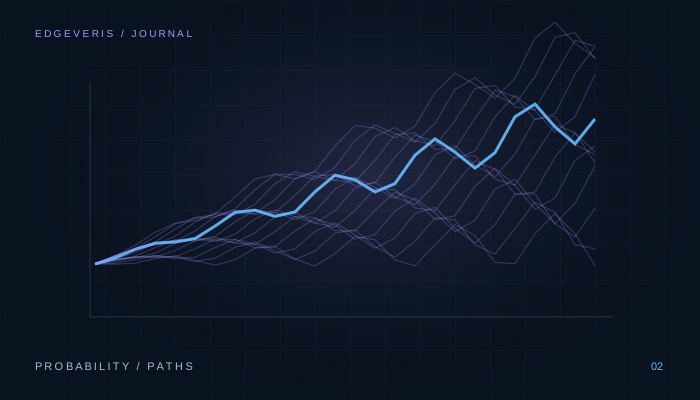
Turn a trade history into probabilities of passing, failing and remaining unfinished without confusing simulation precision with evidence.
Understand what Kelly optimizes and why a challenge's loss boundaries require a different sizing test.
Connect fees, the chance of passing and the chance of actually receiving payouts in one cash-flow model.
Calculate streak probabilities correctly and distinguish them from the chance of breaching an account boundary.
Convert nominal account size into actual loss headroom and understand which boundary can end an attempt.
Trace the difference between a chart signal and an executable fill before trusting a profitable backtest.
Keep the trading logic comparable while testing whether different sizing policies suit evaluation and payout objectives.
Build a test that can be rerun, reconciled trade by trade and compared without mixing code, inputs or data.
Read parameter neighborhoods, costs and out-of-sample evidence before choosing the highest historical score.
Align positioning data with its actual availability and compare strategy equity and drawdown across interpretable regimes.
Separate economic states, release events and revised observations before connecting macro data to strategy performance.
A strong Sharpe ratio means less after a large search. Learn how to put the winner back in context.
Test the selection process itself: does the in-sample winner keep its rank when the data change?
The same trades can produce very different paths. Choose a simulation method that matches the question you are asking.
Separate movement you observed from profit you could actually capture, then test alternative exits without hindsight.
Diversification depends on when losses happen, how exposure overlaps and what capital the combined strategy actually needs.
Find out whether a weekday, hour or month is genuinely useful, or simply the best-looking slice of your backtest.
Test what could have been known at each date, and understand why repeatedly opening the same holdout changes its meaning.